


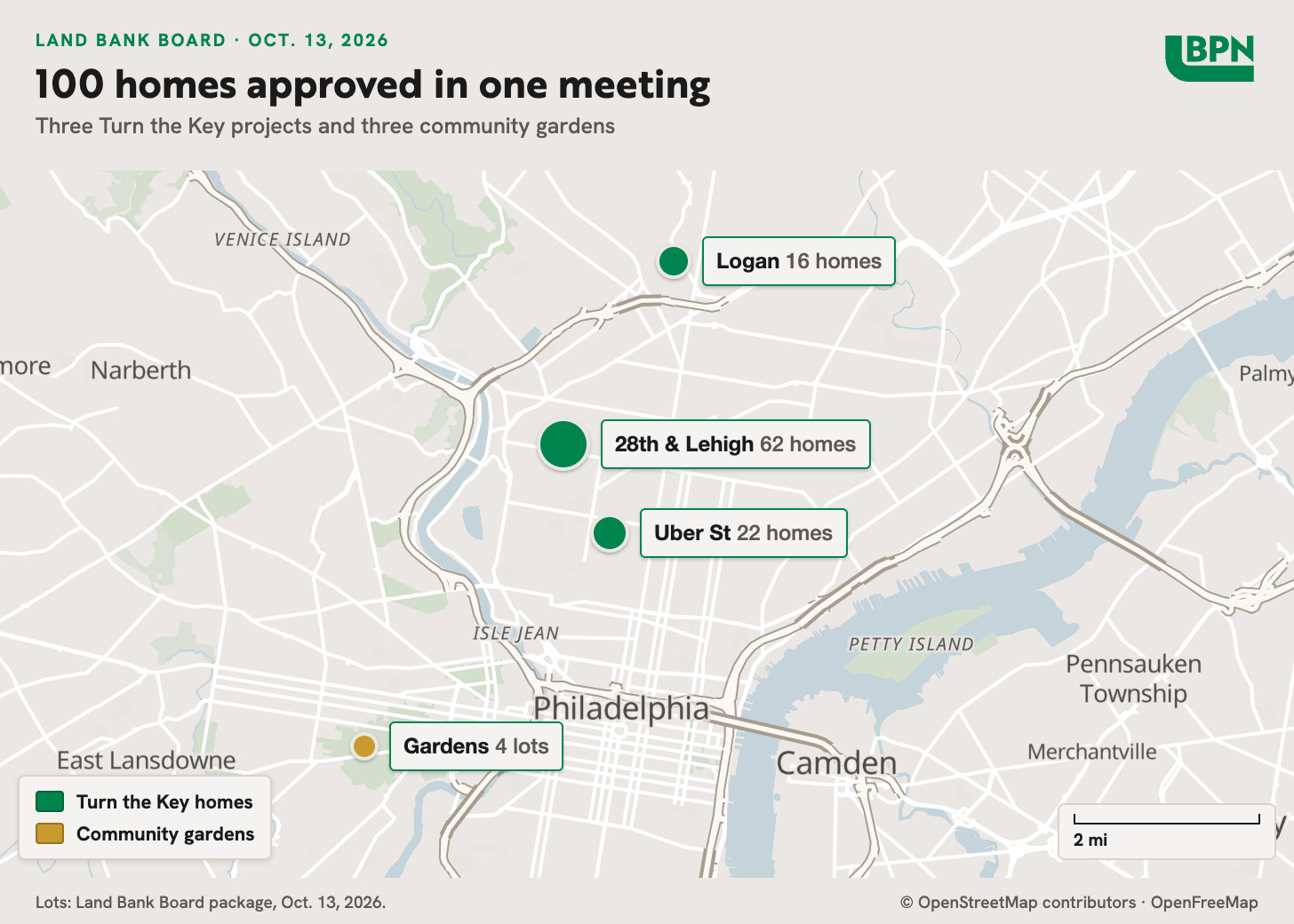
The Land Bank Board unanimously voted to advance 100 Turn the Key homes at its October 13th meeting, on 101 publicly-owned lots.
All are three-bedroom, two-bathroom for-sale homes, priced at up to $280,000 for buyers earning at or below 100% of the area median income, and meeting other Turn the Key program eligibility criteria. The three projects are scattered-site developments: each bundles rowhomes on many separate lots in one neighborhood.
This month’s projects included two RFP awards through requests for proposals (RFPs) and one unsolicited proposal:
62 homes at 28th & Lehigh, RFP awarded to Civetta Property Group (Allegheny West, 4th Council District, RFP)
22 homes on Uber St and nearby blocks, RFP awarded to Civetta and The Maple Corporation (a non-profit) (North Central, 5th Council District)
16 homes. Unsolicited by Flourish (Logan, Council District 8)
The Board also voted unanimously to approve three dispositions to Neighborhood Gardens Trust in the 3rd Council District, covering four lots.
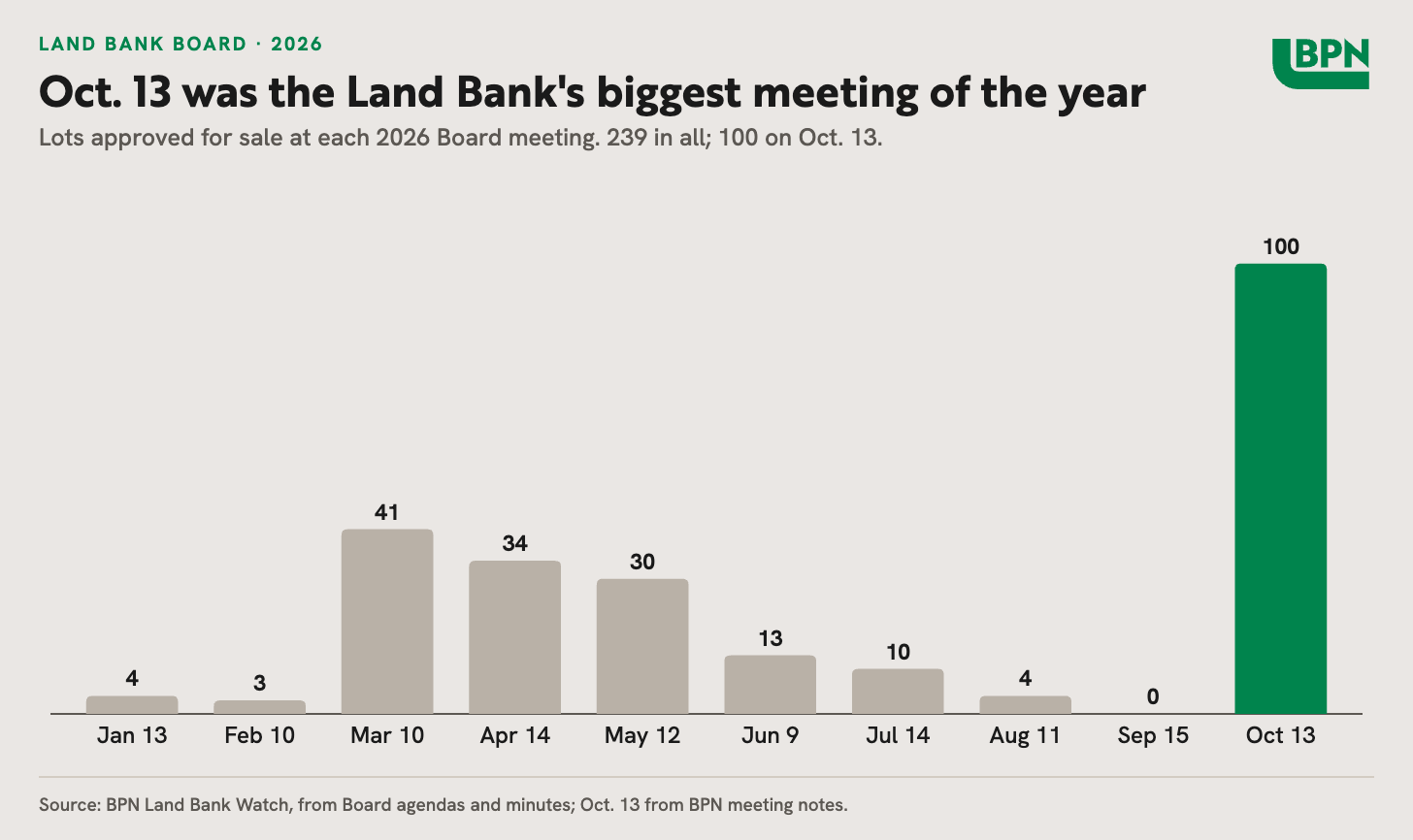
The October meeting was the Land Bank’s biggest of the year, with 100 of the 239 lots approved so far in 2026 moving in a single meeting, all with little fanfare during public comment. The 100 homes are 10% of the 1,000 homes Mayor Parker and City Council agreed to fast-track for disposition in the 2025 H.O.M.E. bond authorization deal. 2026 currently stands at 239 lots disposed, just behind 2022 (302) and 2024 (260).
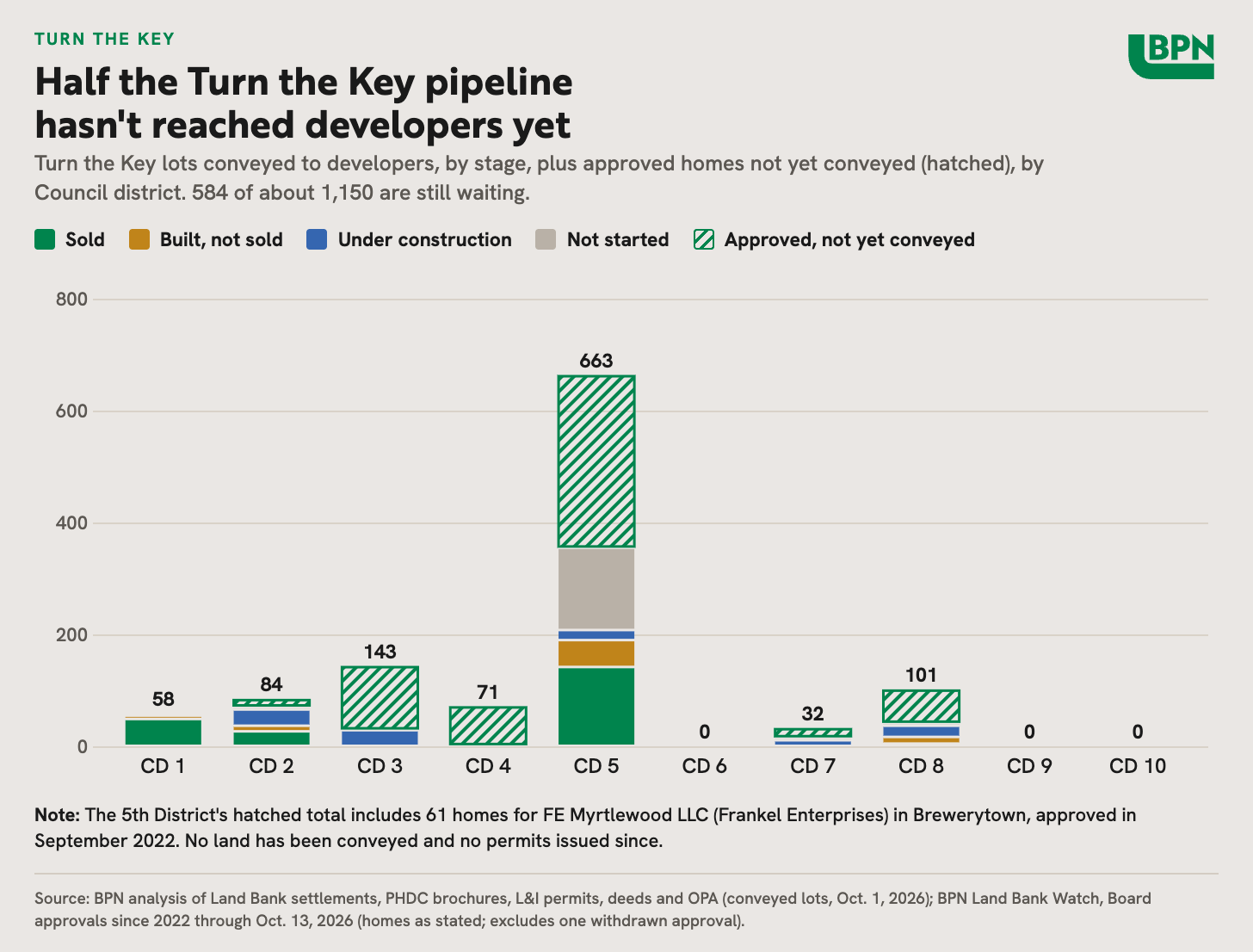
The Land Bank, and ultimately City Council, need to maintain this brisk pace to make enough parcels available to spend all the H.O.M.E. bond revenue that’s been allocated to Turn the Key.
That hinges on Councilmanic Prerogative, the unwritten tradition in which District Councilmembers defer to one another on land use issues, including land dispositions. Despite the agreement to fast-track 1,000 city lots for Turn the Key, it’s still unclear what progress has been made on that tranche of properties.
As Land Bank Executive Director Angel Rodriguez explained at today’s meeting, each Council member has a land strategy, whether formal or informal. Nothing moves without a Council resolution at the end of the process, and no Requests for Proposals go out without City Council’s sign-off. RFPs are the official advertisements for opportunities to bid on land development and other services.
Using District 5 Councilmember Jeffrey Young as an example, Rodriguez noted that unsolicited bids for city land will no longer be considered in District 5, as the Councilmember prefers to work exclusively through RFPs.
The city’s Turn the Key and mixed-income housing laws concerning land disposition both allow for unsolicited proposals, but whether the CM will entertain these or be willing to introduce the eventual resolutions to dispose of the land is what ultimately decides what happens.
Case in point, at the September 15th board meeting, the Land Bank withdrew its approval of Civetta’s Norris Square proposal for 30 Turn the Key homes, because Councilmember Quetcy Lozada had not introduced a resolution for it. The Board had approved the project 6-4 in March, after months of failed votes and postponements.
Data from BPN’s forthcoming Land Bank Watch website, compiled from nearly 7 years’ worth of board minutes, now counts 25 Board-approved projects waiting on City Council, with 8 approvals withdrawn because Council wouldn’t act.
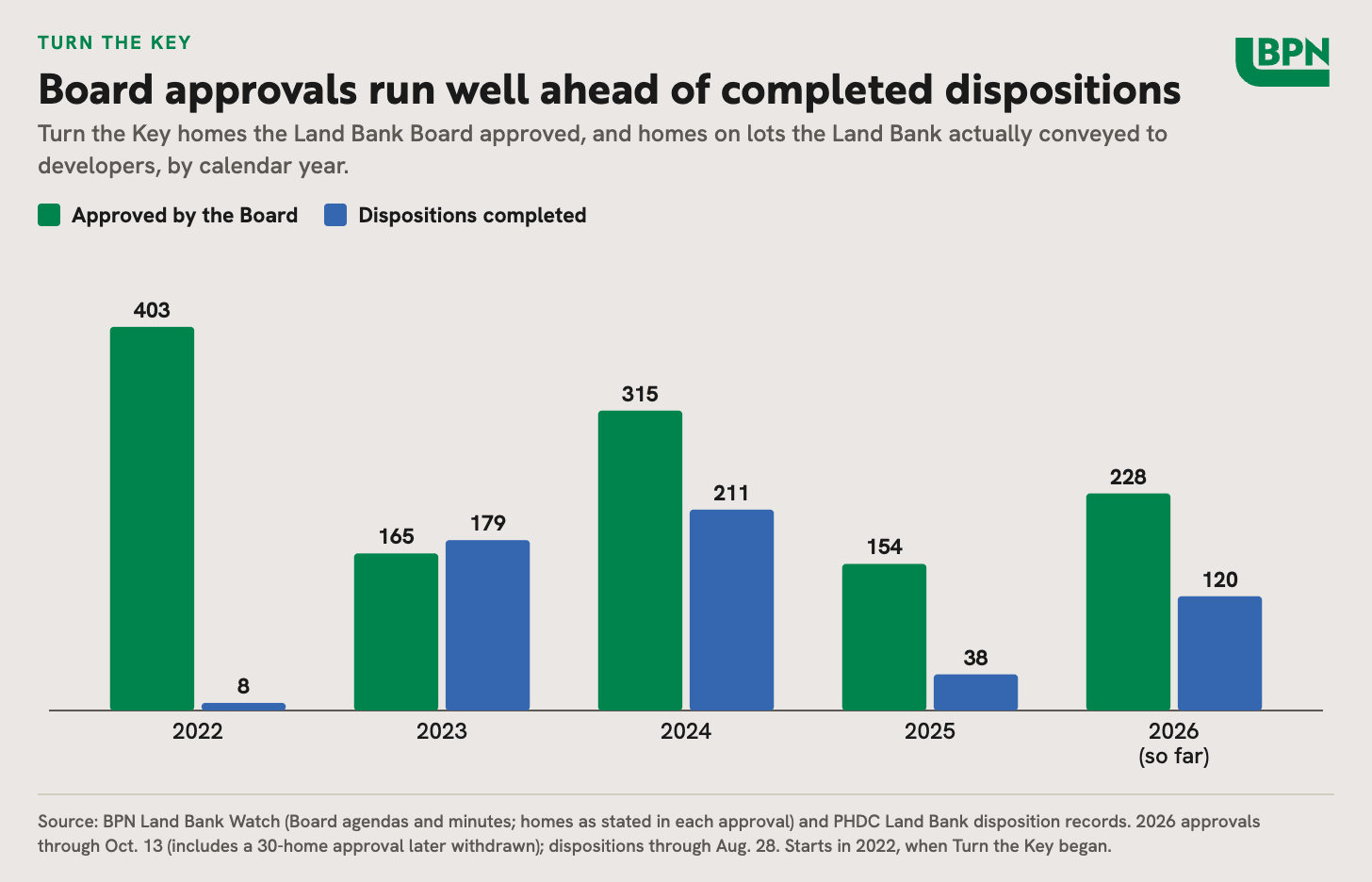
Another issue to keep in mind is that Board approvals are not the same thing as completed dispositions, and the disposition approvals often happen on a long lag after the Land Bank board or Councilmembers act, sometimes up to a year or two years later. More about that on Land Bank Watch soon. That’s part of why it’s important to the pipeline to keep the board approvals moving.
The lots too small for housing
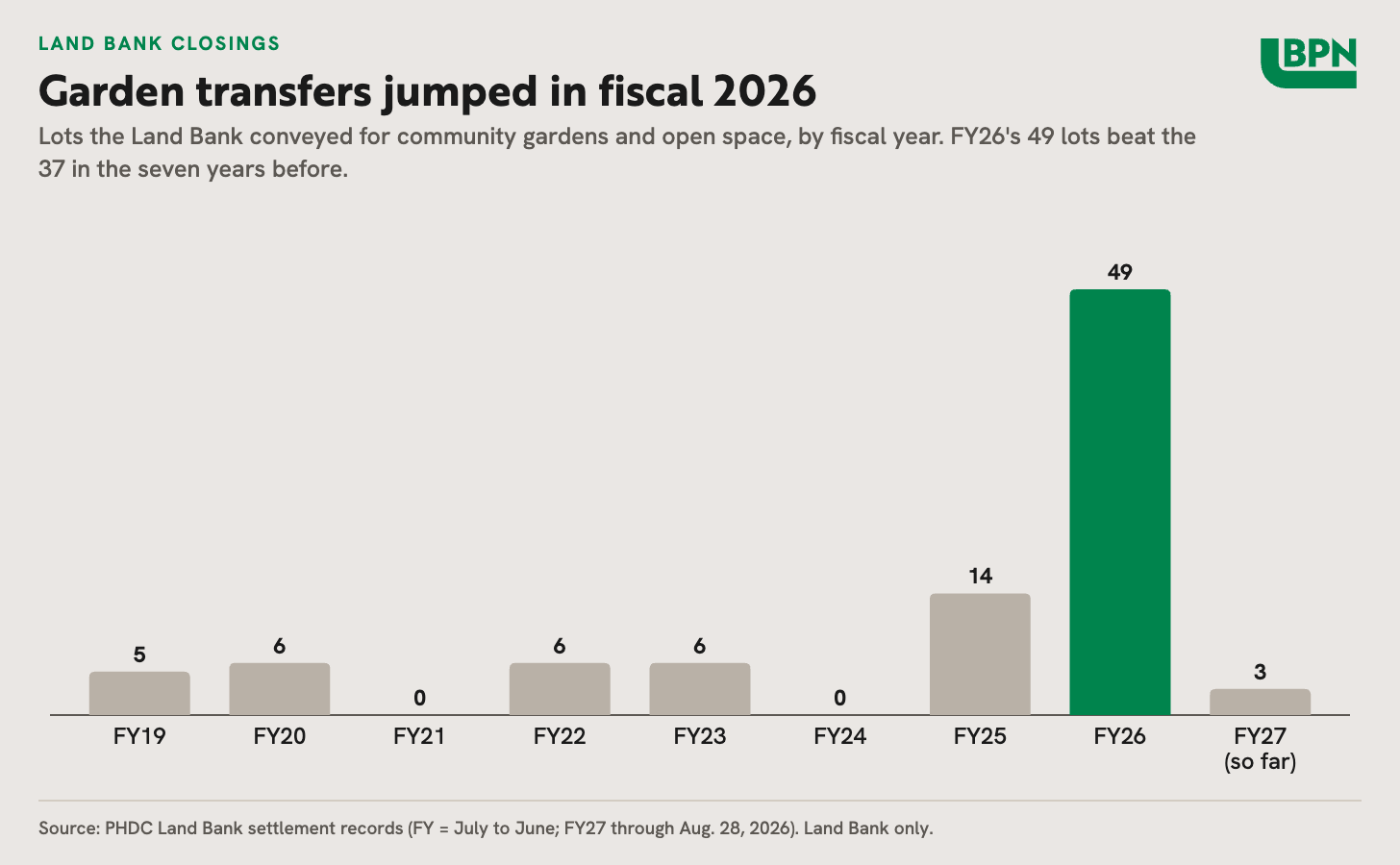
BPN believes housing should be the priority use for city-held land, all else equal, but that we should try to get neighborhood garden organizations the proper land title and insurance to protect existing gardens, or add land to existing gardens where it makes sense. With more than 6,500 public parcels, there’s a lot of land to go around, but not all of it is created equal. Some are in stronger housing markets than others, for one thing.
Conflicts between housing and gardens are less frequent than media and online coverage sometimes suggests, but they do come up, and we think these conflicts could be minimized with more active planning, backed by parcel data analysis of the sort we do here at BPN.
One related question that comes up is whether city parcels are suitable for housing or not, based on size.
Analyzing city property data with our BPN Property Intelligence platform, along with disposition records and board minutes between 2020-2026, shared data at the October 13th meeting about the lots whose shape or neighbors make the decision easy. There are 768 city lots that are smaller than any lot Turn the Key has built on so far.
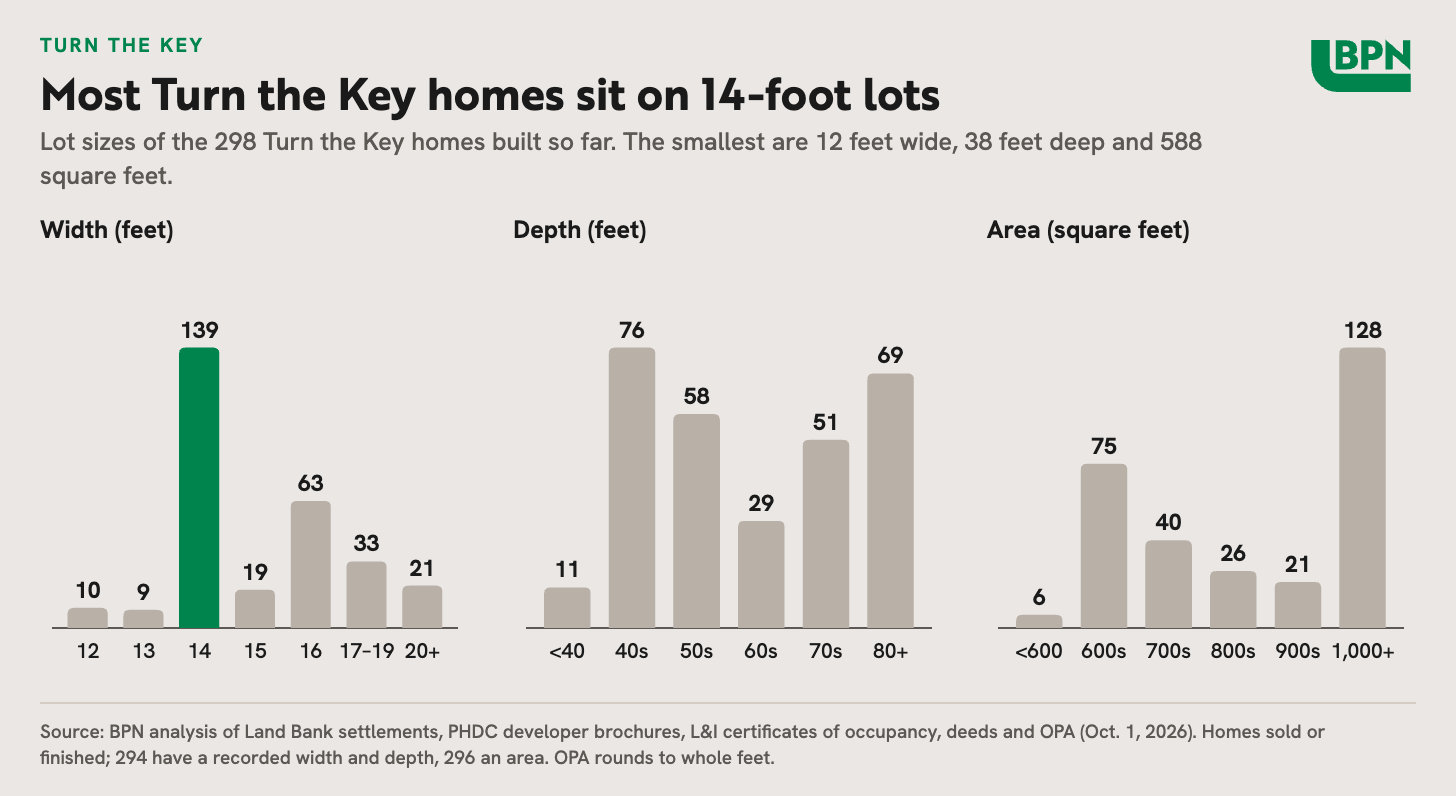
The three smallest Turn the Key homes built thus far are 2704 Jefferson St (13’ wide x 46’ deep), 1414 N 27th St (16’ x 38’), and 936 Edgley St (14’ x 42’). Private developers have built 407 homes on 12-foot lots since 2018, but for quality-of-life’s sake, it’s probably best to build homes on at least 13’ of lot width. Thirteen feet is typical of the smaller Turn the Key lots, so we used it as the minimum.
Out the 6,588 public parcels that are part of our study universe, 768 fall short on width, depth or area; a lot must meet all three minimums to count as suitable for housing. Of these, 226 are narrower than 13 feet, and 221 are shallower than 38 feet.
Many of these could still be housing. Some 466 of them, or 61%, touch another vacant public lot, and could be combined into one or more home-sized parcels.
That leaves 417 lots that can’t hold a home even when combined with neighboring public lots. Of these, 82 border only private homes, so they are good candidates for side yards that could be marketed to next-door owners.
Another 214 lots border private vacant land, and could be candidates for land assemblage—combining multiple lots for a larger project—but that takes more work than a transfer between public agencies. The other 121 have neither a side-yard buyer nor an assemblage partner. They could be offered for community uses, parks and gardens, or small business activities.
Most lots are in fact suitable for housing—at least using the smallest Turn the Key project as the floor—but we now have a good handle on which ones are not. Everything’s more complicated than it looks on paper, but these 417 lots should be easier to dispose of than the rest, because the parcel their shape and neighboring properties have already made the decisions for us.
How the F do we get rid of councilmanic prerogative?! Oof, so annoying and bad for the city.