


Correction: A previous version of this article claimed the Washington Square West Historic District would have been one of Philadelphia’s largest with an unprecedentedly long period of significance. The post has been updated to more clearly describe the district.
In an order dated October 6th, the Court of Common Pleas reversed the Historical Commission’s designation of the Washington Square West Historic District. The district, nominated in 2023, would have been one of Philadelphia’s larger historic districts, containing 1,441 properties, more than half of which were already individually listed on the Philadelphia Register, with a broad period of significance stretching approximately 245 years from 1740 to 1985.
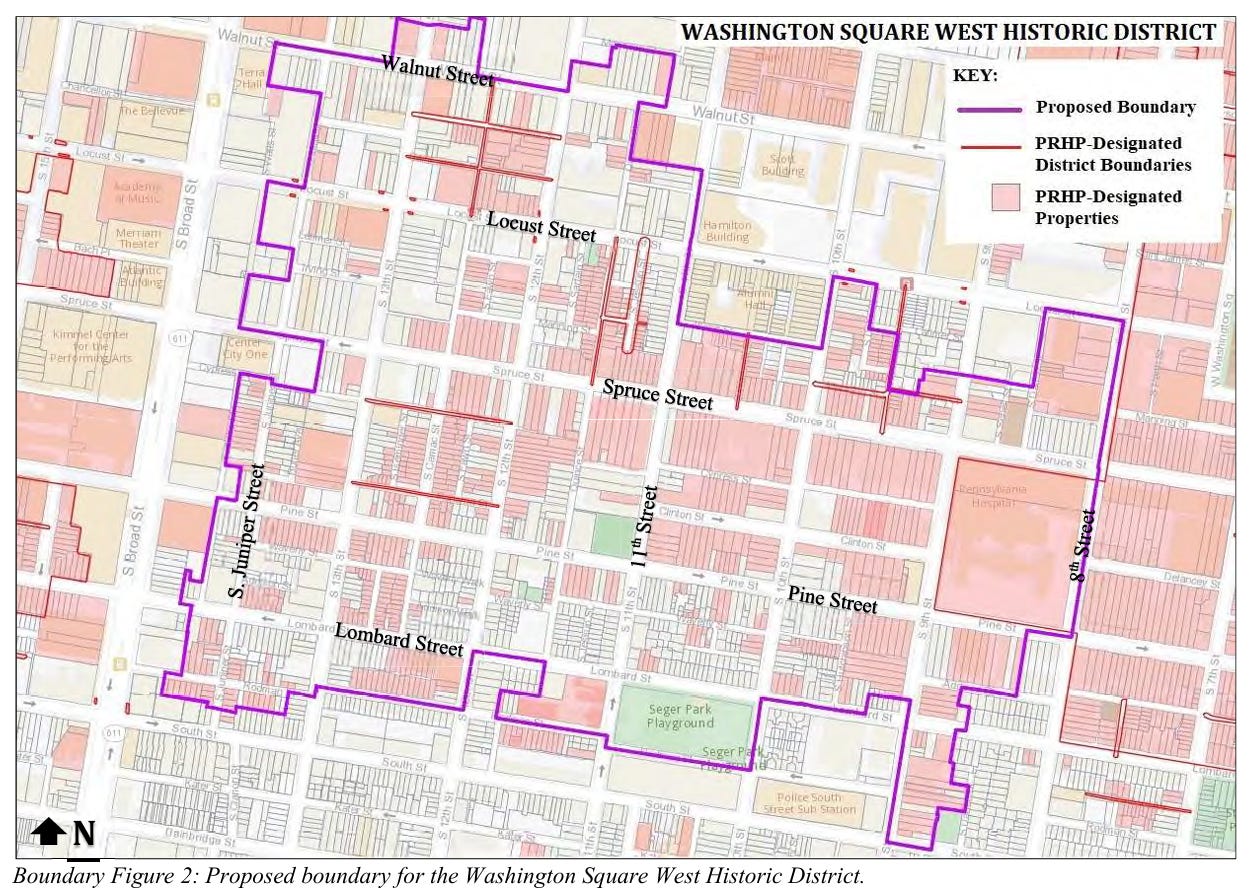
While the district would not be Philadelphia’s largest (Rittenhouse-Fitler contains 2,277 properties today), nor did it have the longest period of significance (Germantown Urban Village’s spans 256 years, 1703–1959, and Old City’s 253 years, 1676–1929), the Washington Square West district was a relatively big swing for the preservation community compared to recent nominations, as it would have protected a large and diverse swathe of Center City in a single district.
The nomination argued that the district met six of the ten criteria for designation (only one is required), the proposed district includes many arguments for its significance, which an attorney for one opposing owner called a “kitchen sink approach.” This included significance to the Black, LGBTQ+, and European immigrant communities, significant architectural styles ranging from Federal to Modernist, possible archaeological value, among other things.
The Court’s decision rested on two grounds: first, procedural concerns about how the nomination was prepared and reviewed; and second, whether the nomination satisfactorily proved its case based on the requirements in the preservation ordinance.
The nomination was co-authored by Commissioner Emily Cooperman, which was submitted by the Preservation Alliance for Greater Philadelphia and the Washington Square West Civic Association. She recused herself from the Commission’s review. The order from Judge Christopher Hall held that the nomination “was not in accordance with law,” citing the City Ethics Code provision (§ 20-602) that bars City officers from representing others in matters involving the City.
The Law Department, representing the City, asked the Court to find that Commissioner Cooperman’s recusal was “sufficient to remove any commingling or due process concerns.” The City further argued that the Court did not have authority to determine that Commissioner Cooperman violated the Ethics Code, as that is the exclusive purview of the Board of Ethics.
The Preservation Alliance, through its attorneys, argued that “Commissioner Cooperman’s role was entirely appropriate” and that she acted “entirely above board and in full compliance with the law.”
The Court found additionally that the nomination itself was not supported by “substantial evidence.” The evidence presented, the Court said, “did not show significant concentration, linkage, or continuity” as required by the Philadelphia Code’s definition of a historic district.
New Documents Detail “We the Youth” Condition and Preservation Options
An October 2025 engineering report from Joseph B. Callaghan, Inc. (JBCI), commissioned by Mural Arts, shed new light on the condition of the Keith Haring “We the Youth” mural and future plans for the site. The mural is currently nominated to the Philadelphia Historic Register, and is scheduled to be presented to the Philadelphia Historical Commission this Friday, 10/9.
According to the engineering report, the owner of the building at the time the report was authored “has proposed demolishing the structure and commissioned an art conservation firm to remove the mural in sections for future off-site restoration,” which is opposed by the Neighborhood Gardens Trust, Mural Arts, and the Keith Haring Foundation, who are advocating for in-place preservation and restoration of the mural.
The assessment found that, overall, the mural and the wall were in fair condition. The stucco the mural is painted on is in poor condition (meaning repair or rehabilitation is required immediately) and is pulling away from the wall. Meanwhile, the mural itself is in good to fair condition, with some isolated areas of paint peeling.
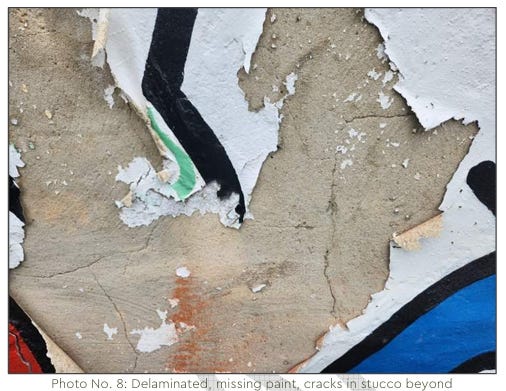
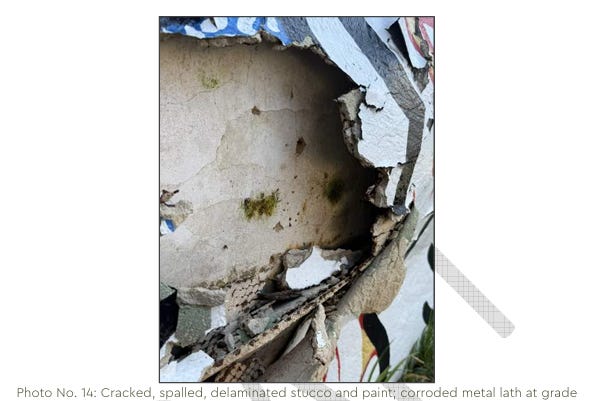
The assessment contemplates six preservation options, ranging from removing the mural from the wall for offsite restoration, to preserving the mural in place, to recreating the mural. The engineering assessment was that the mural would not survive removal, which Ori Feibush, the manager of the LLC that owns the building the mural is painted on, advocated for in September.
The engineers judged that there were two feasible options that would preserve the original mural (the rest would either destroy the original or replace the wall and recreate the mural), but they cautioned that:
“Mural Arts and the Keith Haring Foundation should consider carefully if the expense and effort would be worth the final product. It would remain an old, irregular, brick wall with a stucco finish that may last longer than the 2013 restoration project but will still require regular upkeep and likely more restoration projects in the future as other areas of older stucco start to fail.”